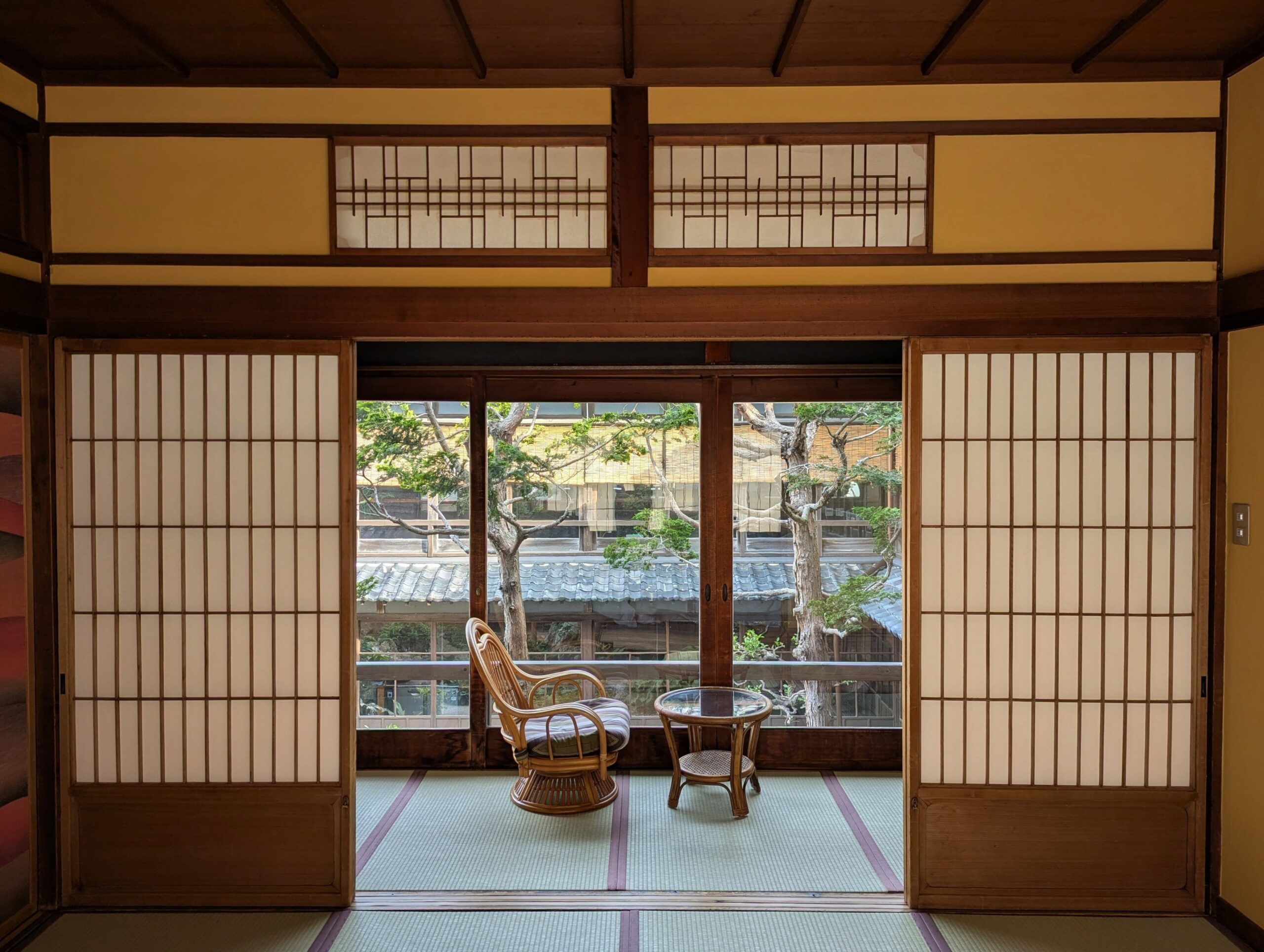
In my previous articles, I have spoken about the wonders of Kakujoro, from its nearly 100-year-old architecture, which offers a charming glimpse into an authentic old Japan becoming increasingly hard to find today, to the scrumptious and elegantly presented vegan kaiseki (traditional Japanese haute) cuisine. But as one might expect from a treasure chest of a ryokan with as much history and character as Kakujoro, I still have much to share from my experience.
Today, I would like to introduce the room I had the pleasure of staying in for two nights back in early June, when the sun-kissed glimmer of cherry blossoms had given way to the rain-laced poise of hydrangeas, creating a fitting atmosphere for the rustic feel of wood-clad Kakujoro.
The story behind the name
Have you ever noticed that ryokan guest rooms are often named, as opposed to numbered?
These names are typically chosen with thoughtful intention, not only to further the traditional Japanese sense of wa, but also to capture each room’s individuality, like its atmosphere, cultural or historical origins, view, and size. Unlike in hotels, where spaces are more or less standardized in terms of layout and design, many ryokan rooms, and this is certainly true for Kakujoro, are one of a kind.
Therefore, rather than being reduced to plain and purely practical numbers, it feels to me like a sign of respect and love that each room is bestowed with a name, a reflection of how deeply it is cherished by the staff, who work tirelessly and passionately to preserve the inn’s legacy, often passed down across generations.
Maybe it is just me, but one of my favorite aspects of staying in a ryokan is ruminating on the story behind my room’s name as I spend time there and let my mind wander as to why it was chosen. Sometimes it is rather straightforward, for example, a room name consisting of the word umi (sea) because it has an ocean view, but other times it is more of an abstract puzzle. The latter is the kind I love, because I feel it invites interpretation and liberates my imagination as far as I want it to go. And my room name at Kakujoro offered just that.
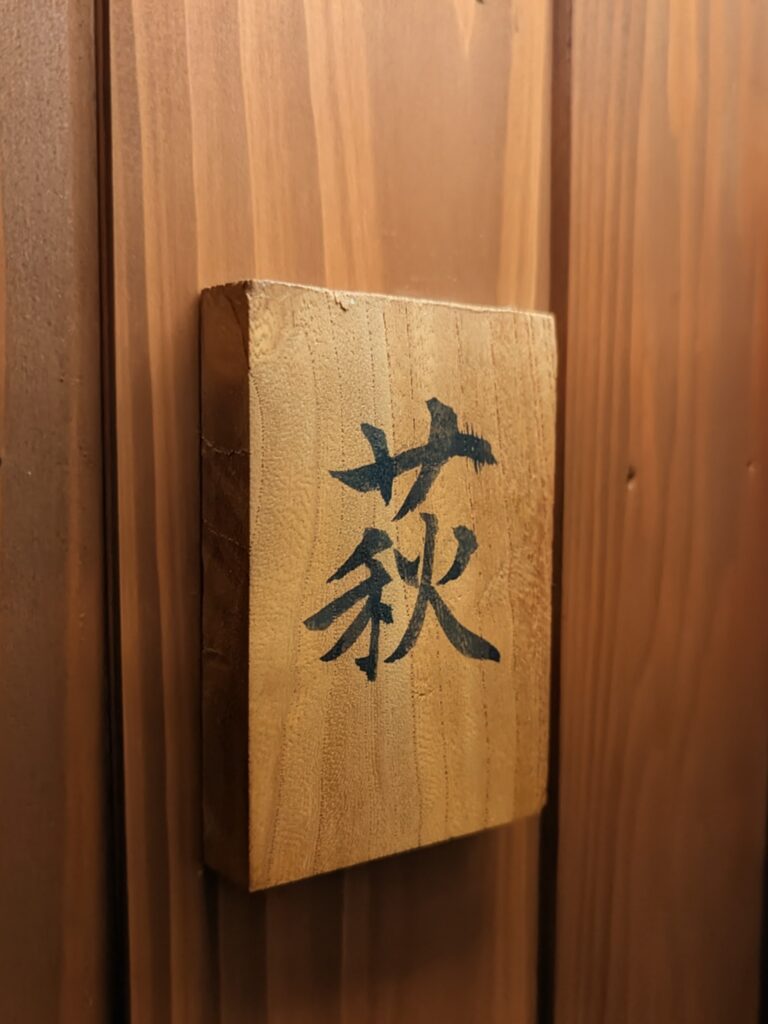
Hagi was the name, and I will expose myself a little here and admit that I had no idea what the word meant. Upon looking at the kanji though, handwritten on a nutty wooden plaque hanging at the entrance, I noticed that it consisted of a kusa kanmuri (艹) with the character for autumn (秋) beneath it: two beautiful clues that awakened my inner amateur detective.
The kusa kanmuri symbol is often used in words related to or derived from plants, so, for example, the characters for flower (花) and tea (茶) both include this component. Even before entering the room, the name put me in a serene headspace, evoking imagery of a quiet yet expressive autumn.
And as soon as I entered, I understood the choice for the name.
Stepping inside the room
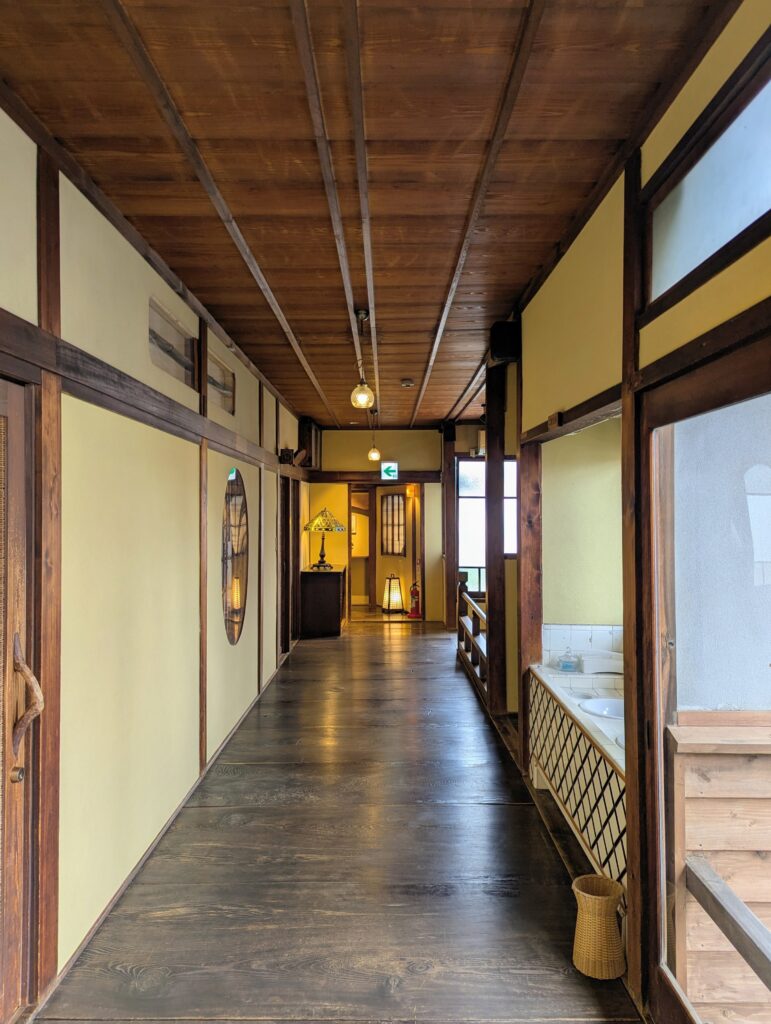
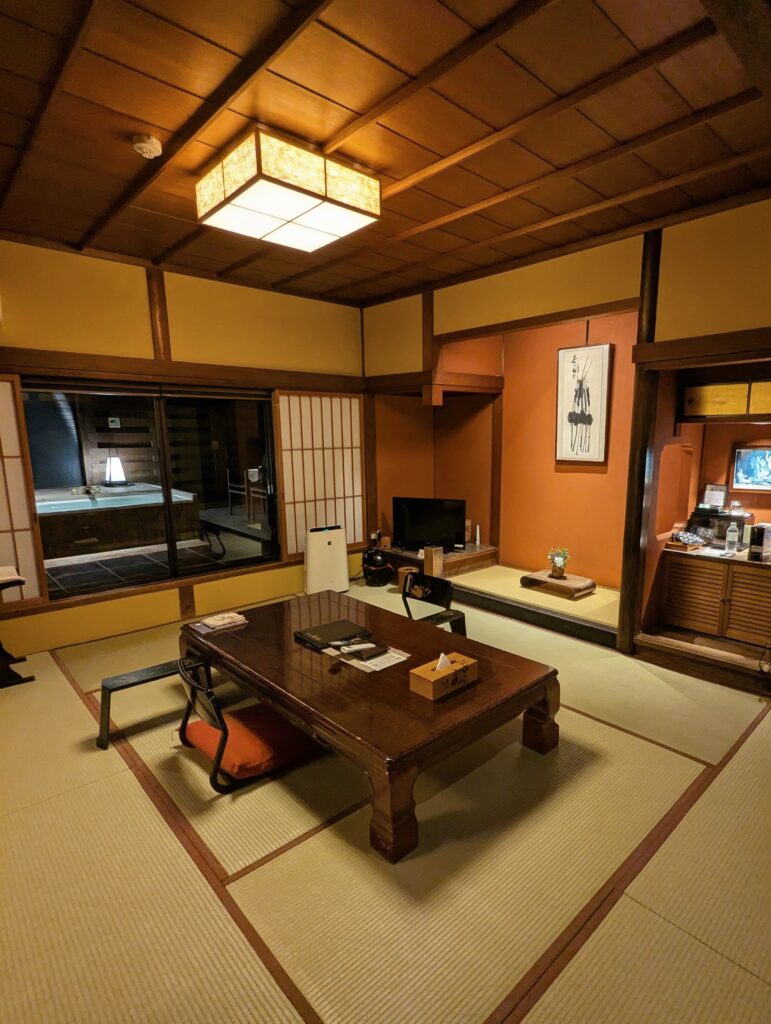
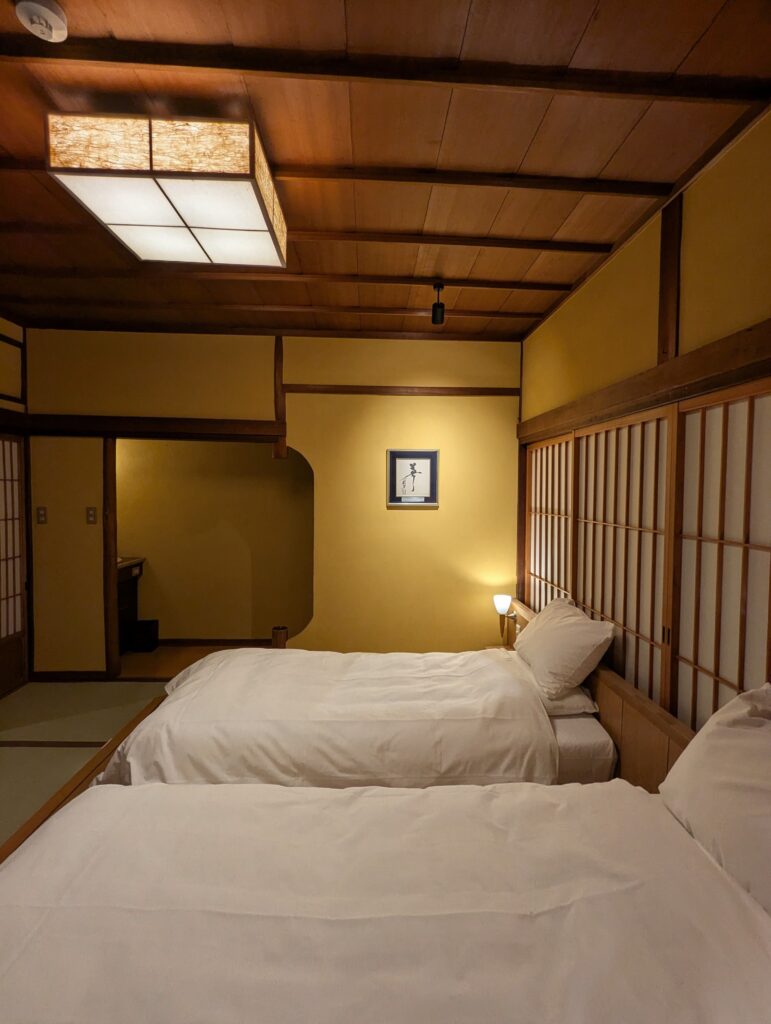
The familiar, natural green of tatami was accented by beautiful browns, yellows, and reds enveloping the walls and furnishings, from the grand low table in glossy chestnut to the bedroom walls painted a creamy mustard. It was as though I had stepped into the cozy palette of autumn.
The recurring wavy pattern on several doors was particularly striking, adding a contemporary flair to the largely traditional Japanese aesthetic. Come to think of it, there were several elements in the room where the traditional existed in masterful harmony with modern convenience: the two Western-style beds placed on tatami, access to high-speed Wi-Fi in a space that dates back nearly a century, and a convenient (well, obligatory to me) coffee machine sitting next to the tokonoma, a raised alcove where flowers and Japanese calligraphy are typically displayed. The merging of the old and new was seamless, and restrained enough that the room’s rich history was still spotlighted front and center.
Oh, and did I mention the private rotenburo (open-air) bath? Looking as though it had been renovated rather recently, the bath uses groundwater pumped up from the Tenryū River, which traverses more than 200 kilometers from Japan’s Southern Alps through three prefectures, and rests atop modern-chic panels of maroon stone, offering yet another way to luxuriously unwind.
That night, as I sank into the top-notch comfort of the bed, I Googled what hagi meant and learned that it refers to bush clover, a flowering plant native to Japan. Lo and behold, it is one of aki no nanakusa (the “seven flowers of autumn”), blooming during the seasonal transition from July to October. I had been wondering why the door patterns I loved infused shades of blue and green with red and orange, so when I learned about the hagi flower and the time of year it blooms, I realized it likely represents the overlapping color palettes of summer and autumn.
With its typically purple petals blooming on slender branches like the wings of butterflies, hagi has long been beloved, and it is the flower mentioned most frequently in the Man’yōshū, Japan’s oldest existing anthology of poetry, compiled more than 1,200 years ago.
The story of the room was gently unfurling.
A morning gift: Birdsong and a Japanese garden
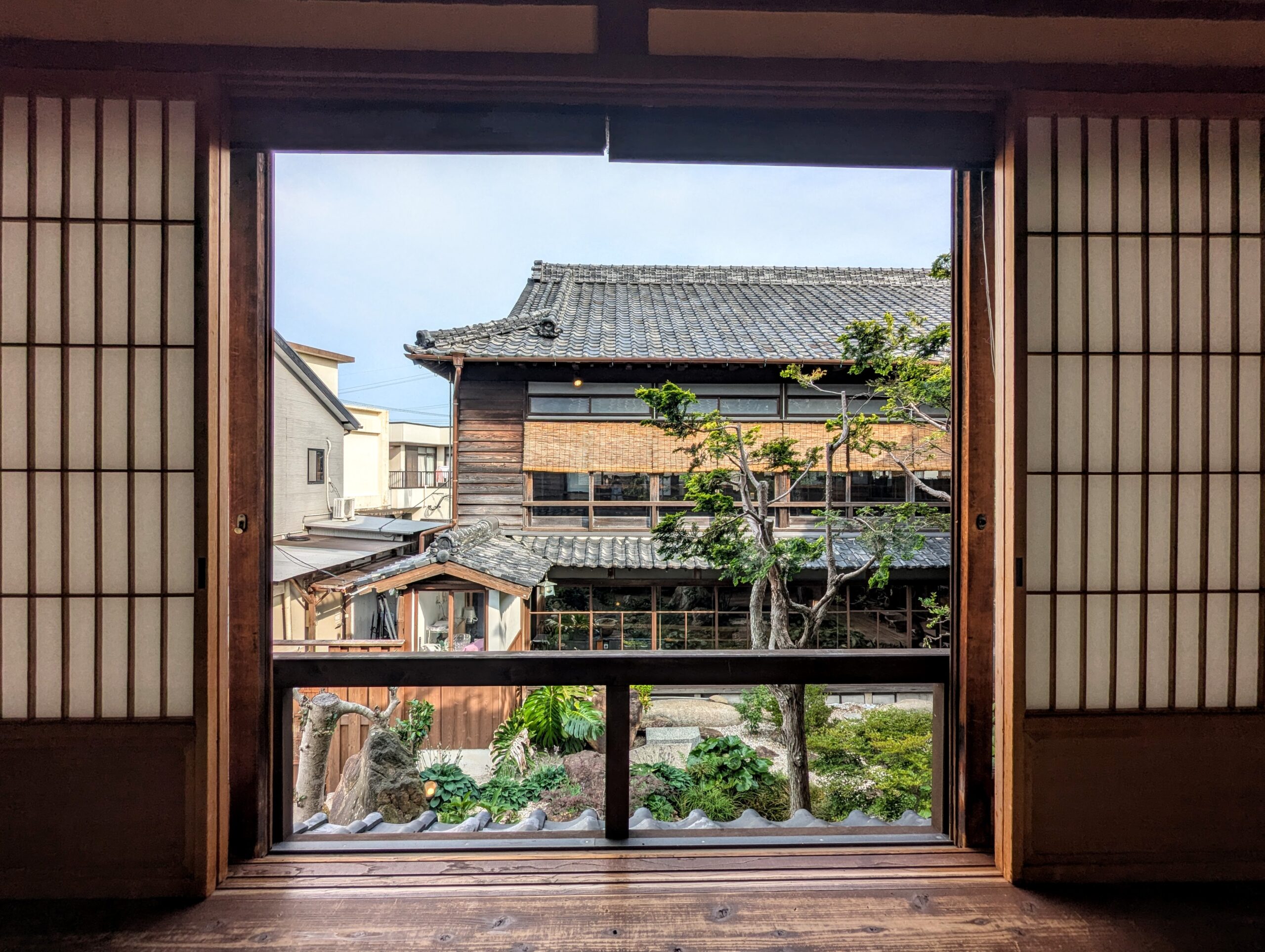
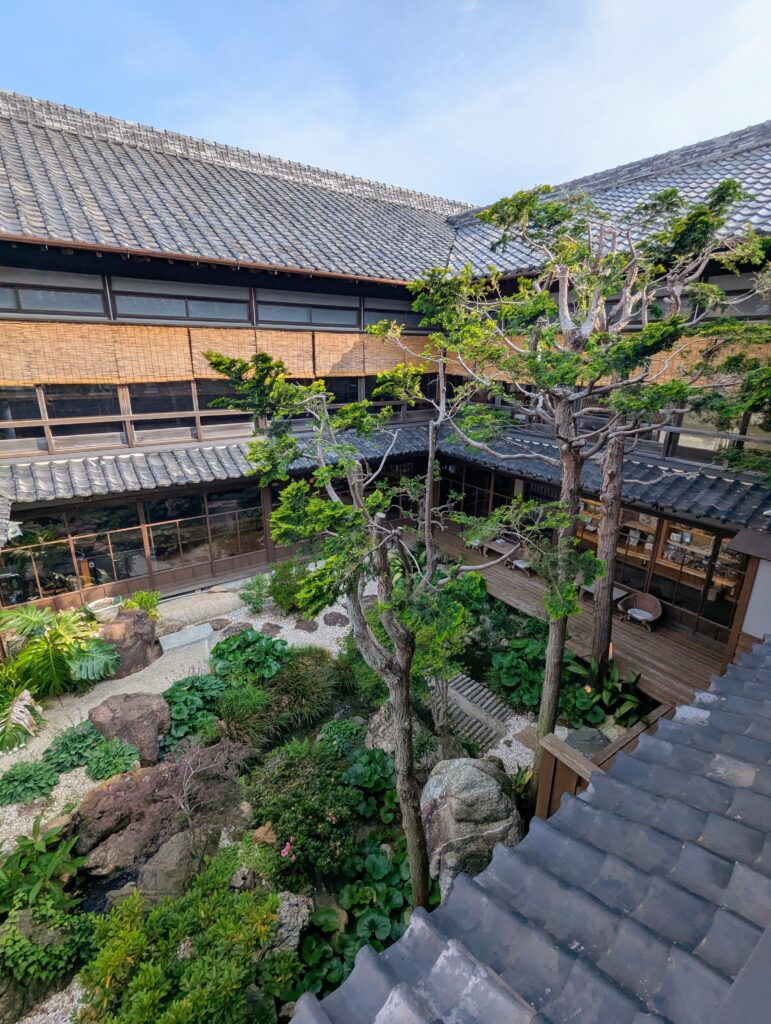
I kid you not, I felt like I was waking up in the middle of a forest (albeit on a very comfortable bed), because I was lulled awake by the chirping of birds that sounded amazingly close to my ears. It was only then that I realized my room overlooked the most beautiful Japanese garden, with three tall trees that, of course, housed those little chirping sparrows who kindly made for the most soothing morning alarm.
Since I had arrived late the previous evening, I had no idea this magnificent view would be waiting for me, and I further understood the intention behind the nature-centered hagi name.
The day was graced with lovely blue skies, so I went to crack open the huge sliding windows to let the breeze in. That was when I found what was probably my favorite little detail of the entire room. It was a bronze-colored metal pin slotted perfectly into the window frame, keeping it securely closed. It took me a couple of gentle tries, after which I managed to pull it out just enough to slide the windows open.
It was so cool to catch a glimpse of the kind of old-school engineering used nearly a century ago, and while the mechanism is, of course, different, it was fun to be reminded that the same simple need to keep windows secure existed back then too. Moments like these make me feel closer to history, seeing it as people much like ourselves living in a different time, rather than as a foreign or distant past.

Coming full circle
Just as red roses symbolize love, Japan also has its own hanakotoba, or language of flowers. As my stay approached its final hour, I looked up the hanakotoba of hagi, and three themes emerged.
- Contemplation: Hagi blooms with a slight downward tilt on its slender branches, said to resemble someone deep in thought. Its pensive posture feels in tune with the mood of autumn.
- Modesty: This is reflected in the understated beauty of hagi, one that does not assert itself too strongly.
- Tenderness: Its branches, though slender, are flexible. There is a tenderness in the way they sway calmly with the wind.
Looking back on how I felt after spending two beautiful nights in the room, hagi truly felt like the perfect name.
With delicious coffee in hand, seated on a wooden chair overlooking the meticulously maintained Japanese garden below, I savored my last hour, wrapping myself in the contemplative, modest, and tender aura of hagi, hoping to carry its beautiful autumnal qualities with me as I soon exited and stepped into the June monsoon air.