
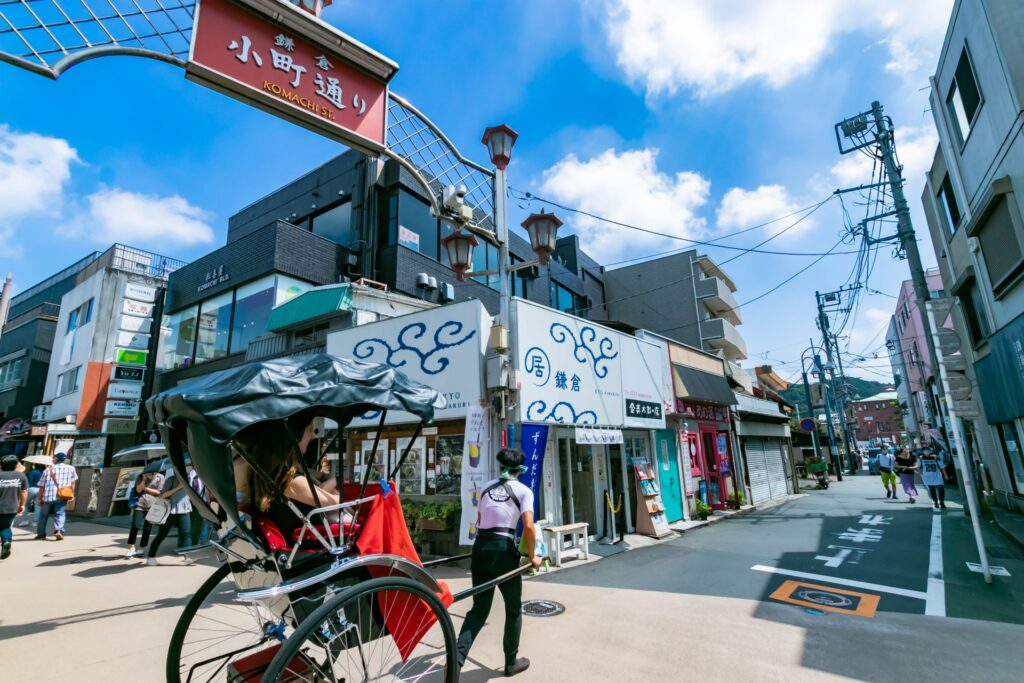
A jinrikisha (rickshaw) is a traditional wooden carriage with two wheels pulled by a person, commonly seen in historically significant areas. As one of Japan’s most iconic forms of transportation, it’s a unique and photogenic way for tourists to explore.
Where and when to enjoy a jinrikisha ride
You can often find jinrikisha around Japan’s most famous historical tourist sites, such as Asakusa in Tokyo, Arashiyama in Kyoto, and Kamakura. Your driver also doubles as a guide who will give you fascinating insights into the various landmarks you encounter on the route while answering any questions you might have about the area.
Sightseeing can be hard on the feet, so a jinrikisha ride can be the perfect opportunity to take in the sights while also getting a great photo op!
Surprisingly new, nonetheless iconic
The history of jinrikisha in Japan is surprisingly short, being developed around the beginning of the Meiji period (1868 – 1912). In fact, the use of wheeled vehicles was heavily restricted during the preceding Edo period (1603 – 1868). With the old restrictions gone, jinrikisha quickly became one of Japan’s most important forms of urban transportation for a brief period. However, by the early 1900s, automobiles, streetcars, and trains increasingly replaced jinrikisha as everyday transportation, with the person-powered vehicle evolving into an experience for tourists and remaining an iconic image of Japan.
Aspiring jinrikisha drivers must be physically fit and learn how to expertly maneuver their vehicles — imagine pulling two people and a cart in the sweltering heat of summer! Amid the physical exertion they must also have great customer service skills and a knowledge of the area and its history. Not an easy job, to say the least!
These great qualities make the drivers the star of the show, and for those who enjoy chatting with a guide or love Meiji vibes, riding a jinrikisha can be a once-in-a-lifetime experience.
FAQ
- How much does a jinrikisha ride cost?
-
Many operators charge per ride (with one rickshaw usually able to accommodate two people), rather than per person. Short rides of 10 or 15 minutes can cost 5,000 yen or less, while longer ones of 1 hour or so can come in at around 20,000 yen.
- Traditionally, who rode in jinrikisha?
-
In their heyday, a range of urban residents and city visitors — from wealthy businesspeople and government workers to women and families — used jinrikisha.
- Can I ride a jinrikisha without speaking Japanese?
-
Some jinrikisha drivers may speak English (and/or other languages), but even with a language barrier you can still enjoy the ride. Certainly, drivers and operators won’t turn away paying customers!