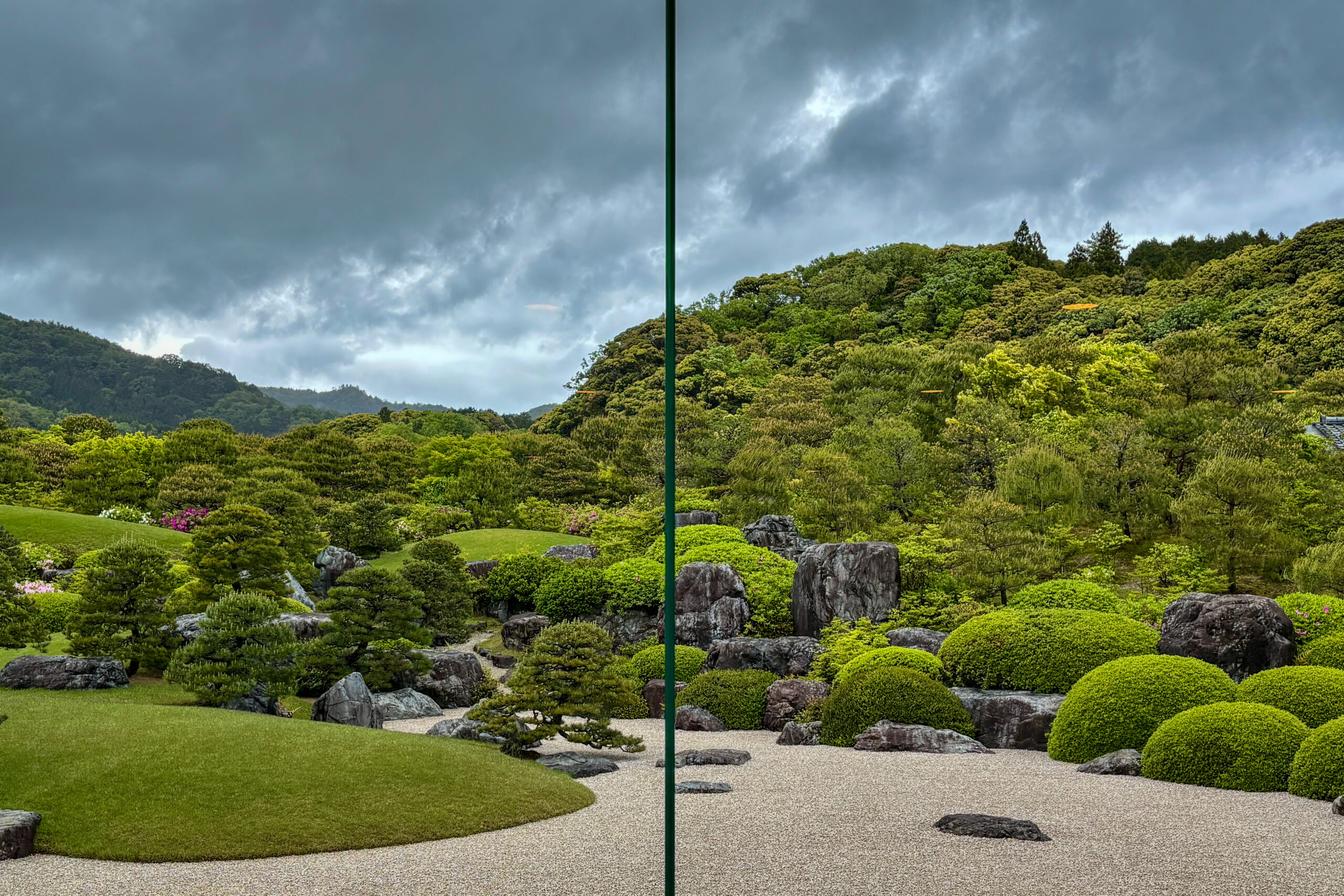
When Zenko Adachi opened his museum in the rural town of Yasugi, Shimane Prefecture, in 1970, he was proposing a place where the act of looking at a painting and the act of looking out a window would become, in essence, the same act.
The son of a farming family in what was then a remote corner of western Honshū, Adachi was not a man born into privilege or the art world. He left home at 15 to cart charcoal on foot to the port of Yasugi, a distance of 15 kilometres, working within the region’s steelmaking industry before gradually building a diversified business empire. Yet throughout his ascent, two passions ran alongside commerce: a deep love for nihonga (the tradition of Japanese-style painting that flourished through the Meiji, Taishō, and Shōwa eras) and an almost devotional relationship with the natural landscapes of his home prefecture. For Adachi, these were facets of the same sensibility, and the museum he created would be their living proof.
The institution that bears his name now holds approximately 2,000 works, including ceramics, calligraphy, and children’s paintings, as well as what is regarded as the world’s foremost collection of works by Taikan Yokoyama, the towering figure of modern Japanese painting. Around 120 Yokoyama works are in the museum’s possession, with roughly 20 on permanent display at any time.
A dive into the history of Japanese gardens
Adachi’s guiding conviction was simple: the garden is also a painting. He did not mean this as metaphor but as a design principle, an institutional philosophy, and ultimately a perceptual challenge extended to every visitor who walks through the museum’s doors.
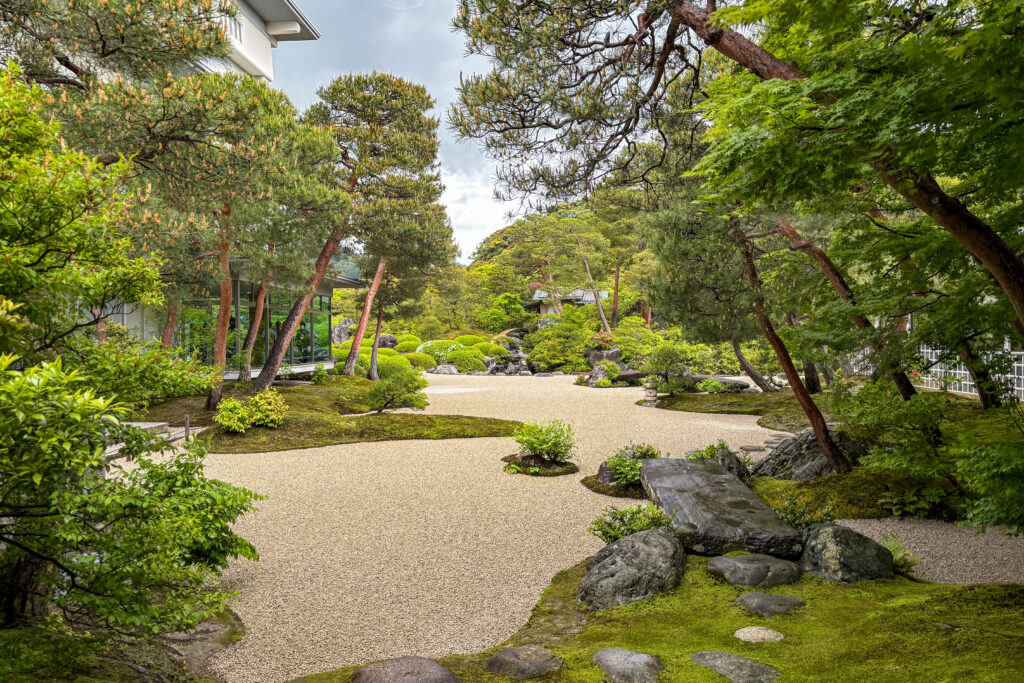
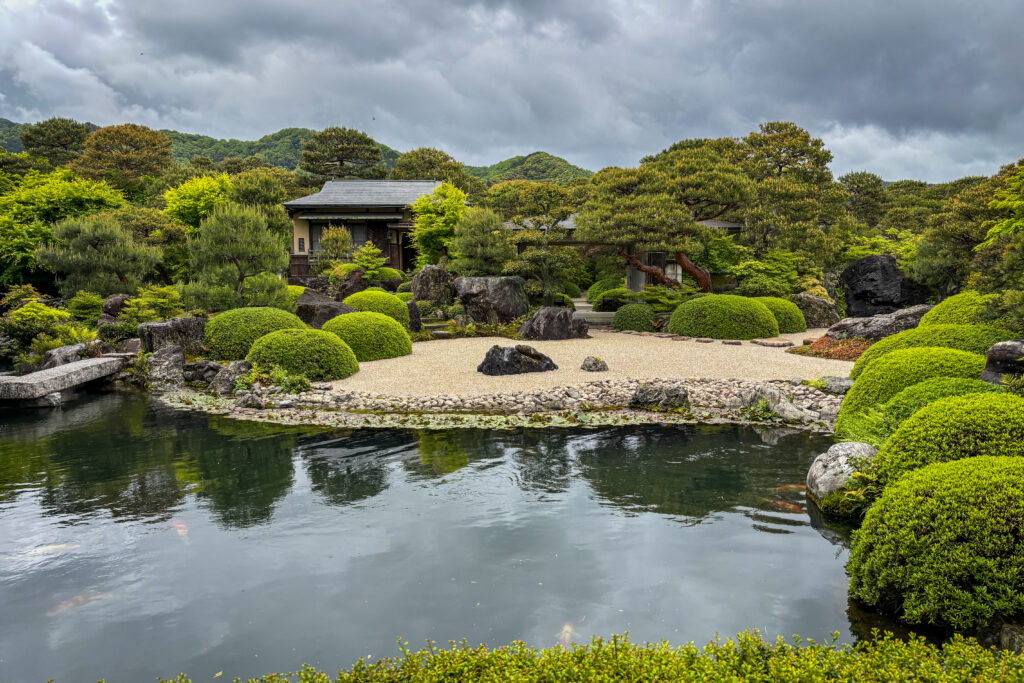
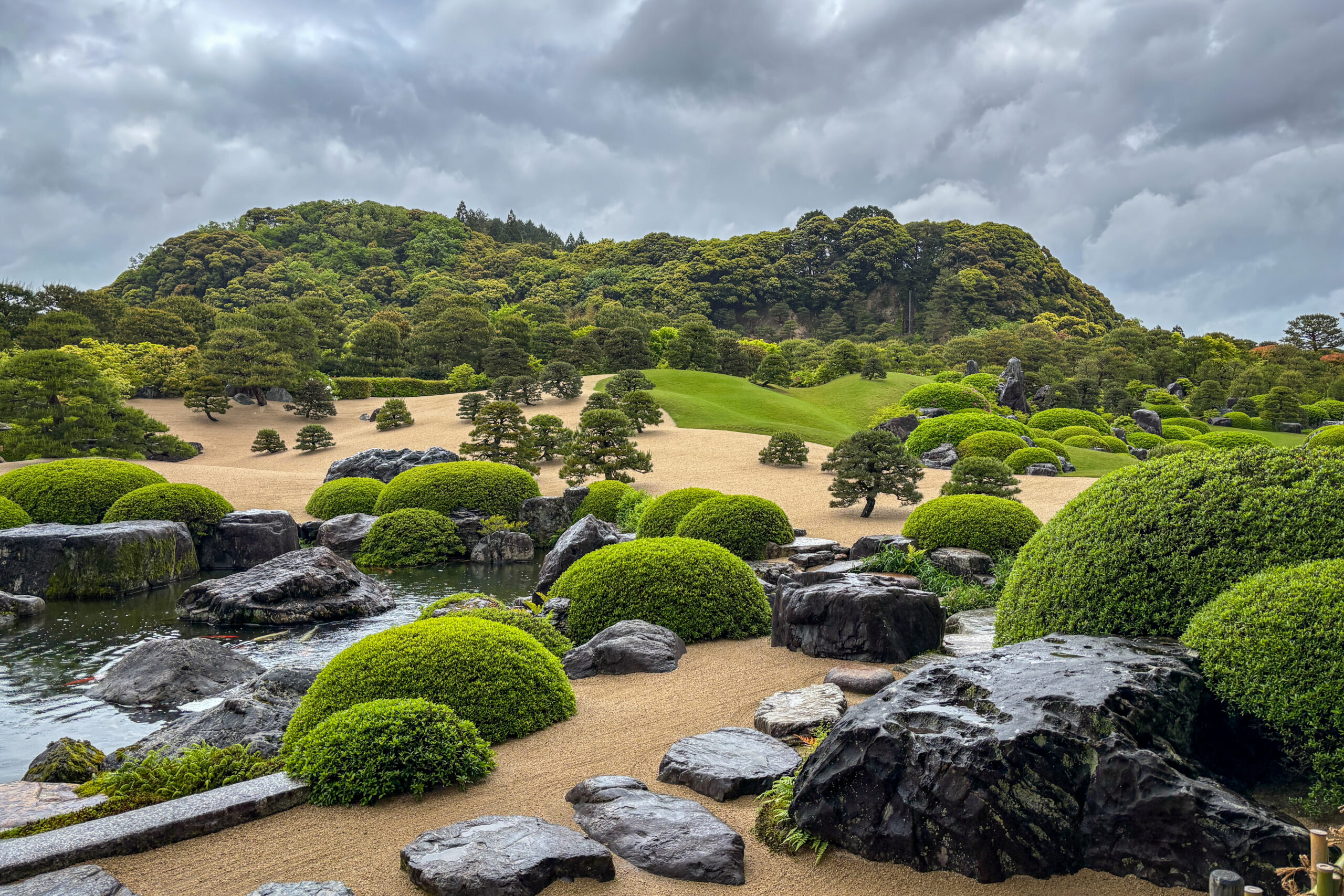
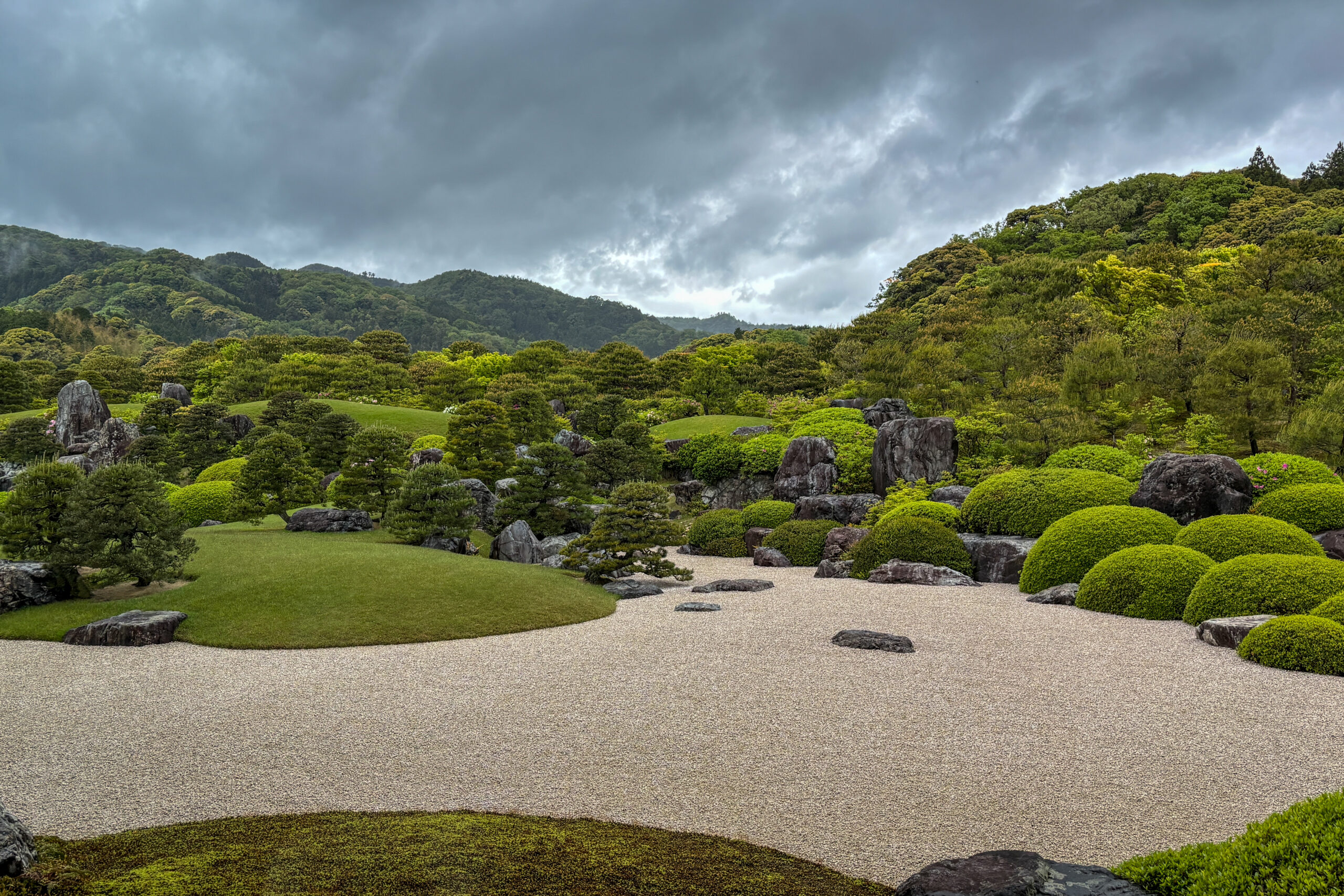
The gardens that surround and permeate the museum complex cover some 165,000 square metres, comprising six distinct sections, including a karesansui (dry landscape) garden, a moss garden, a pond garden, a tea garden, and the celebrated White Gravel and Pine Garden, each rooted in a different moment of Japanese garden history. Designed by Kinsaku Nakane, who was also responsible for the garden at Taizō-in temple in Kyoto’s Myōshinji complex, they are the other half of the collection.
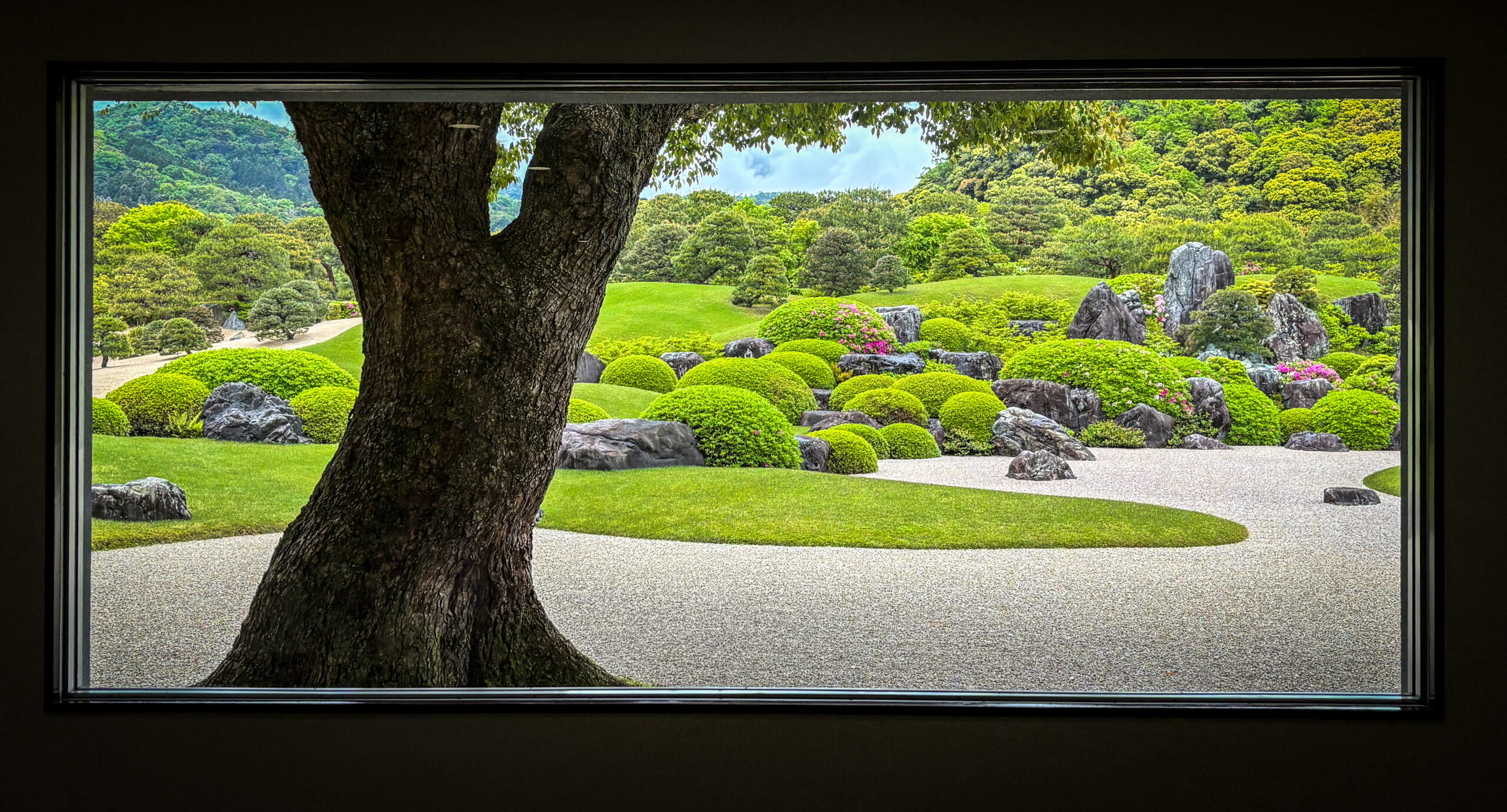
Unlike most Japanese gardens, which invite strolling, contemplation through movement, and the gradual unfolding of composed views, Adachi’s gardens cannot be entered, and are experienced exclusively from within the museum buildings, through floor-to-ceiling windows, from precisely positioned viewing corridors, and through two architectural devices that have become the museum’s most iconic features. The first is what the museum calls the Living Framed Painting, a large rectangular window, framed like a canvas, through which a section of garden is presented as though it were a hanging work of art. The second, the Living Hanging Scroll, frames a vertical sliver of landscape in the shape of a traditional kakejiku, the scroll format central to Japanese interior aesthetics.
Both are invitations to notice, as a painter notices, the quality of morning light on raked gravel, the weight of snow on a sculpted pine, the way autumn colour moves through a hillside incorporated into the garden’s composition via the classical technique of shakkei, or borrowed scenery. The distant Shimane mountains become, through this device, part of the garden’s design, and the garden becomes, in turn, part of the painting you are standing before inside.
The White Gravel and Pine Garden makes this dialogue explicit. It was conceived as a direct recreation of Yokoyama’s 1937 masterpiece Beautiful Pine Beach, a monochromatic vision of pines rising from pale sand along a Japanese shoreline. To stand before the actual painting and then turn to look at its three-dimensional, living iteration, is to experience something unusual in contemporary museum culture.
Yokoyama and the nihonga tradition
To fully appreciate what Adachi created, one must understand something of the tradition he was honouring, and the art-historical moment from which nihonga emerged.
Taikan Yokoyama was born in 1868, the year of the Meiji Restoration, and his long career (he died in 1958, at the age of 89) unfolded against the backdrop of Japan’s turbulent encounter with Western modernity. Nihonga, as a defined movement, arose partly in reaction to the rapid adoption of Western oil painting techniques that characterised the early Meiji period. Painters like Yokoyama, working under the influence of the visionary art educator Ernest Fenollosa and his Japanese collaborator Tenshin Okakura, sought to renew the classical Japanese painting tradition with its ink-wash techniques, its mineral pigments on silk or paper, its compositional debt to Chinese literati painting and to Zen aesthetics, without simply imitating the past.
The result, in Yokoyama’s hands, was an art of extraordinary atmospheric power. His paintings of mist-veiled mountains, of the sea at dusk, of Mount Fuji seen across water in changing seasons, are meditations on “ma”, the Japanese concept of negative space, of the meaningful interval, of what is withheld as much as what is shown.
The nihonga tradition is, at its roots, a tradition of attentive looking at the natural world. The seasonal rotation of works, with different pieces displayed in spring, summer, autumn, and winter, reinforces this logic. The art changes as the light changes, as the maples redden and the snow settles on the karesansui garden’s raked lines.
The museum as a way of seeing
The garden’s inaccessibility, which can initially frustrate visitors accustomed to immersive garden experiences, turns out to be philosophically precise. You cannot enter the painting, you can only look. And in looking, you are invited into a patient and receptive mode of perception that the nihonga tradition has been training for centuries.
For 22 consecutive years, the Adachi Museum’s gardens have been ranked the finest in Japan by the Journal of Japanese Gardening, the American publication that surveys the country’s garden culture annually. The museum has also earned three stars in the Michelin Green Guide Japan, an honour that reflects the rarity of what it offers. In the tradition that Zenko Adachi spent his life collecting and honouring, the garden, the painting, the season, and the quality of your own attention are all part of the same work.