
My first-ever car was a 1974 Mustang Ghia hardtop, and wow, what a car it was. V-8 engine, bright white upholstery inside, and a sharp sapphire body. Driving the Mustang to the beach back home in Hawaii remains a warm memory from my seishun (hanabadda dayz) that will stay with me forever.

Also warm in mind, however physically cold it was in the weather sense, are memories of my second car. This was a nearly fluorescent, lime-green 1971 Volkswagen Karmann Ghia I drove in Boston during my senior year at Tufts. One winter morning, before a drive to the shore, I remember my roommate and me trying to scrape a thick layer of ice off the windshield. Once it was clear, we left the parking lot with the sunroof open, the Dolby speakers blasting the Beastie Boys, and laughed joyously into the sharp Massachusetts wind. What a time!

In both of these cars, I added depth to my personal story while continuing the legacy they already held. The sapphire Mustang was originally owned by an elderly couple near my home in Hawaii, and it was clear from the low mileage on the odometer, the absence of even a single scratch on the shining sapphire body, and the mint condition of the upholstery inside that it had received some serious TLC. What had clearly been a precious chapter in the previous owners’ story was now becoming a part of mine.
My lime-green Karmann Ghia was discovered by my sister in Virginia, and after receiving it from her, I drove it up to Boston with my dear father in the passenger seat. We could feel every bump and pothole on the northbound highway, and we could hear the gears grind whenever I shifted up or down. This was a true antique and had surely been tweaked, oiled, and polished by loving owners over many, many years. I appreciated the time and effort it took to preserve this piece of history, and I assumed the responsibility of maintaining that level of care and keeping its story alive.
Needless to say, the best part about both of these cars was their proud legacy. I loved their “lived-in and cherished” aspect, and I felt honored to carry on their legacy in my own unique way.
Recently, my friend Claire Ghyselen started a boutique salon for antique kimono that, much like a classic car, passes on the stories and beauty of these legacy pieces. Her kimono come from antique shops in Kyoto or from private collections, where they have been lovingly cared for over the years but rarely used. Instead of leaving these beautiful works of art perfectly folded in their kiritansu (traditional Japanese paulownia-wood wardrobes), owners entrust their pieces to Claire, who reimagines and renews them with the help of her dedicated team of expert designers.
Kimonogatari is for people like me who value an inherited kimono as much as they would a precious classic car. Kimonogatari itself is a name that combines kimono with monogatari, or “story.” For each antique kimono that comes under her care, Claire and her design team reimagine the lovely piece of art into one-of-a-kind blouses, jackets, and suits that are tailor-made for their new steward. Keeping her capacity at around eight orders per month, Claire is laser-focused on keeping each kimono’s story alive and well.
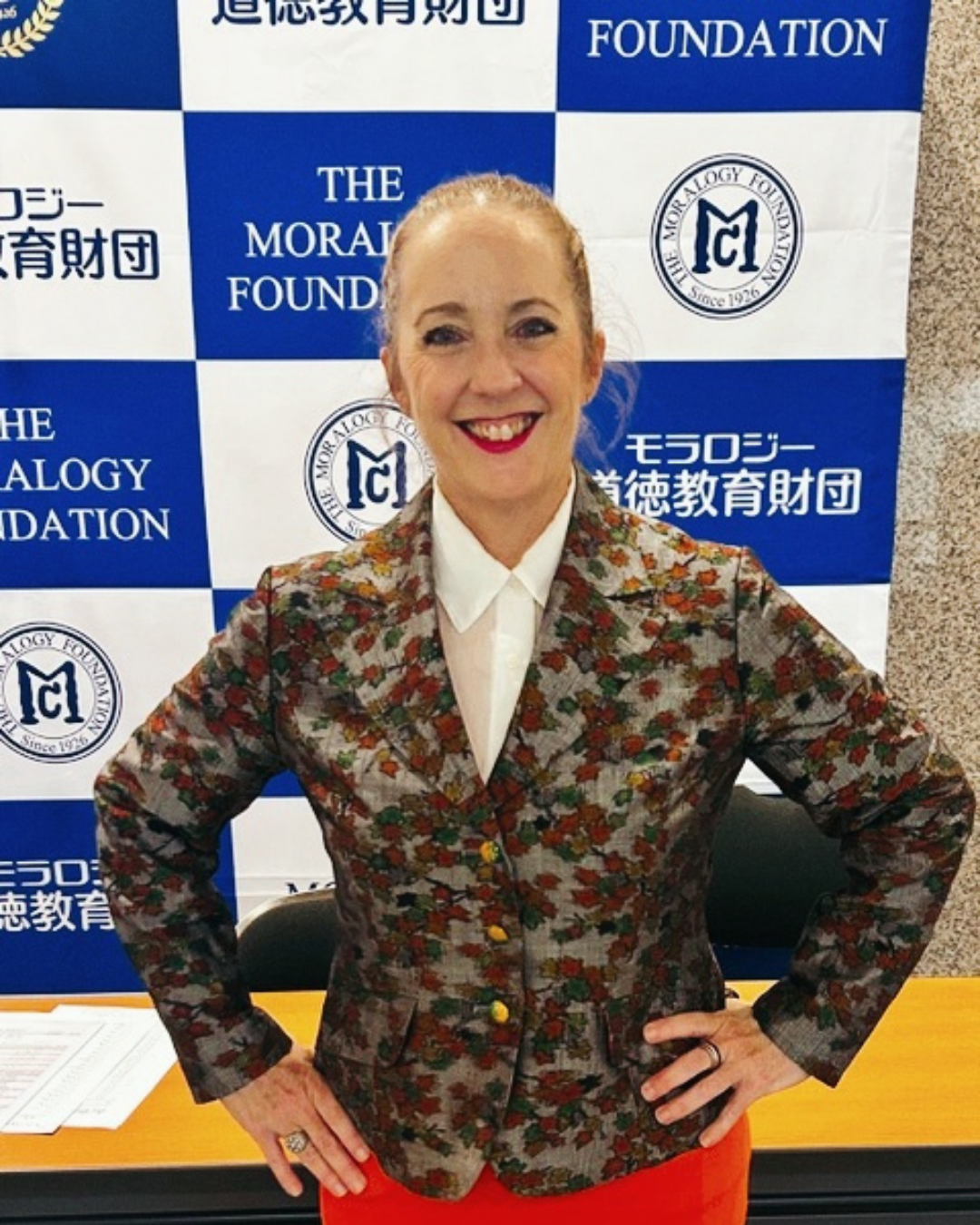
I visited her atelier in Tokyo and was able to browse various sample garments, as well as select my kimono from some 30 different kimono types displayed on her huge dining room table. I selected a fall-themed kimono with bright maple leaves of orange and yellow floating across a background of deep grey silk. I was measured in her private and comfortable boudoir, and the finished jacket and skirt were delivered within two months.
Claire explained that the process of carefully removing the garment’s intricate stitching, having it specially cleaned by an expert in Osaka, creating a pattern with her designer, and then sewing the finished pieces with her adroit dressmaker always takes a few months. Claire also sources beautiful buttons from her home in Belgium or when she visits Paris and other parts of Europe. I was also extremely pleased to see that the russet-orange lining of the kimono had been used perfectly for the lining of my “new” jacket and skirt. What perfect attention to detail.

Claire’s home features a glowing photo of her smiling brightly with her mother. The precious furniture pieces she carefully maintains, inherited from her grandmother, and the TLC she gives the aged cat she adopted a few years ago all come together to tell me some of HER story. I can easily tell that Claire not only values beautiful people and things but also has an aesthetic that values the “soul” within those people and things.
Now that I have inherited and become steward of my own Kimonogatari, I can’t help but imagine the artisan as her experienced hands carefully wove silk thread into bright maple leaves floating on silver-grey. I imagine the woman who selected this tanmono (bolt of kimono fabric) from the various bolts that were surely presented to her at the boutique. I can almost taste the bitter green tea she sipped and the wagashi confection she nibbled on as she considered which design would suit her best. After that, I imagine, she would have been measured, and the completed kimono itself would have been delivered with much fanfare a few weeks or months later.
Would she stand in front of her sugata-kagami (full-length mirror) and hold her different obi (sashes) up against the yellows, oranges, and silver-grey of the kimono? Would she think about which obijime (braided cord) would best complement the autumn vibe of her kimono, just as I do now when matching a blouse or shoes with the suit I’ve received?
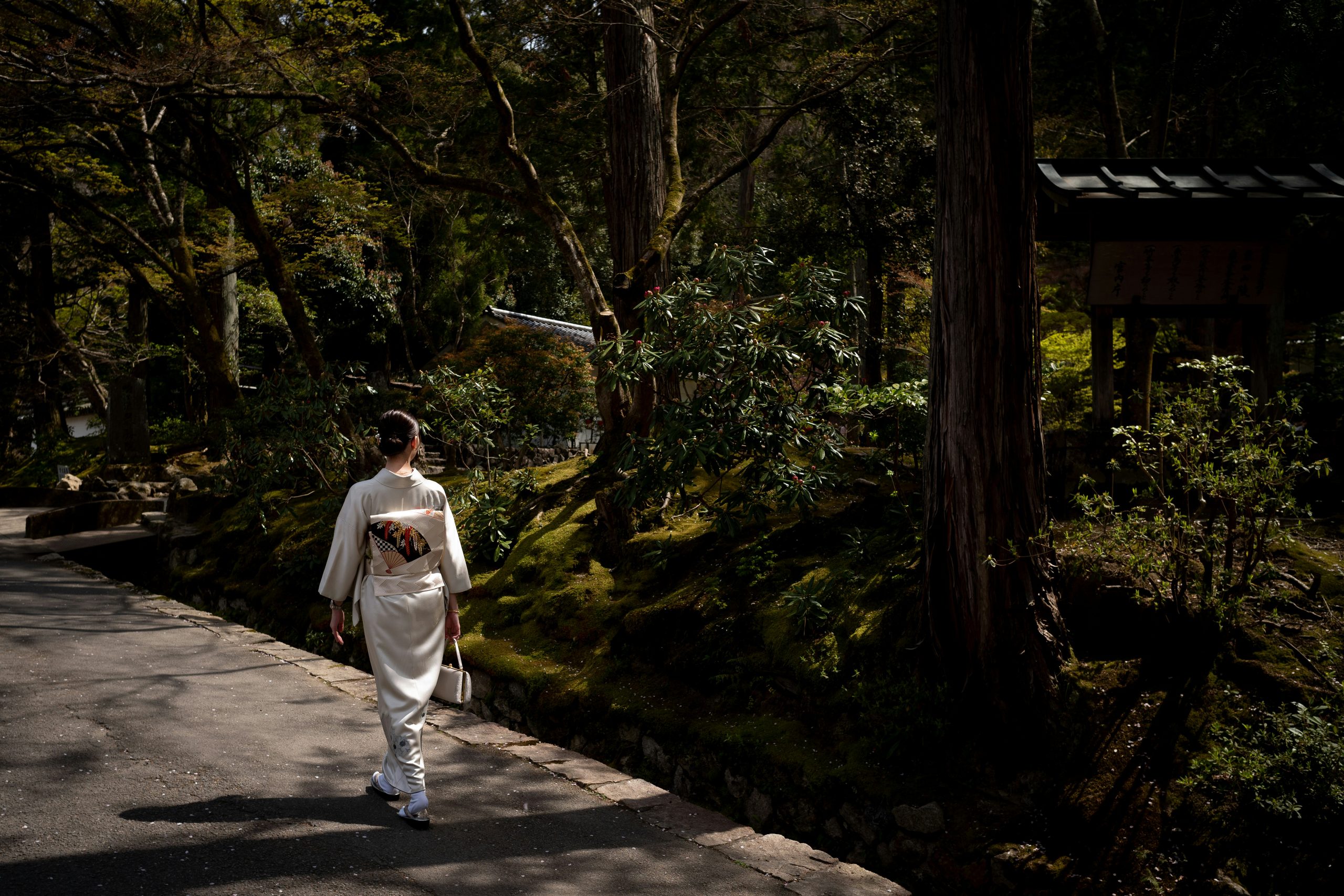
As I do my makeup and twist my hair into a chignon in front of my mirror, I imagine her deciding which eri (neckline collar) to insert or which kanzashi (hairpin) to use to decorate her hair.
Later in the evening, I feel deep gratitude for the woman who began this Kimonogatari as I reach forward to exchange meishi (business cards) with a new contact at a Chamber of Commerce gala. I realize that the bright maple leaf design quietly expresses my respect for this art, for Japan, and for all the people who have contributed to making this moment happen.
I feel great kansha (gratitude) for the silk threads woven together to create this material; for the woman who likely wore this kimono with joy beneath a bright blue autumn sky; for the gentle care of Claire and her team as they reimagine this piece of history in a new form; and, finally, for the opportunity to share this legacy in a room reverberating with international entrepreneurial buzz.
Through all of us, another chapter in this kimono’s story has begun.
Do you want to reinvent one of the lovely kimonos in your collection? Would you like to acquire a bespoke piece like this from the capable hands of Claire and her team of experts? I understand she has room for about four to five more orders each month. If nothing else, I encourage you to visit her atelier and hear her lovely monogatari firsthand.